
A Knowledge Graph for the Agri-Food Sector

Raul Palma leads the data analytics and semantics department at the Poznan Supercomputing and Networking Center (PSNC), where he coordinates the R&D activities and the center’s participation in various EU projects around these topics. In this guest post for the metaphacts blog, Raul explains how knowledge graph technology can address data integration challenges in the agri-food sector, showcasing it through a few use cases. He describes how he leveraged metaphactory to build a domain-specific application - FOODIE - that delivers intuitive access to distributed, heterogeneous data sources and allows end users to extract meaningful insights.
FOODIE is an agriculture knowledge hub delivered as a Web application built on top of metaphactory Knowledge Graph platform. The application enables an integrated view and access over multiple datasets which have been collected from various and heterogeneous sources relevant to the agriculture sector, transformed, and published as Linked Data / in a Knowledge Graph.
The game plan for your Knowledge Graph-driven FAIR Data platform in Life Sciences and Pharma
At metaphacts we help customers leverage knowledge graphs to unlock the value of their data assets and drive digital transformation. We started out with this mission in 2014 and, since then, we've served a multitude of customers in pharma and life sciences, engineering and manufacturing, finance and insurance, as well as digital humanities and cultural heritage.
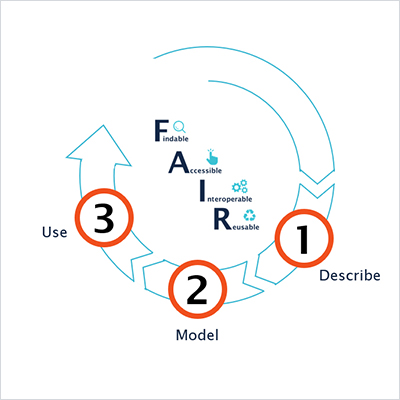
This blog post will give you an overview of what we have developed in customer projects over the years as our game plan to build a Knowledge Graph-driven, FAIR Data platform and drive digital transformation with data. The post will show you how our product metaphactory can support you every step of the way, and will highlight examples from the life sciences and pharma domains.
Smart Solutions for Identifying Compatible Components - Powered by metaphactory and RDFox

Determining compatibility between individual entities is an essential process for many businesses, across various industries and business models; from industrial configuration, supply chain, bill of materials, evaluating terms in contracts, or even for match making apps. The process may sometimes require the user to check hundreds of thousands or millions of possible combinations, to assess whether components fit together, or if components meet specified requirements. Additional factors may also need to be taken into account, for example, regulations or customer budgets. Traditional approaches are inefficient for modern day applications due to the large volumes of data, heterogeneity of data formats, complexity of customer specifications, and concerns over scalability.
The default graph demystified

The SPARQL default graph is a concept that can confuse even frequent SPARQL users. In this article, we will go over what the default graph actually is, why it seems to be something different in every RDF database, and how you can come to grips with those differences and query with confidence.
We will also address the most common challenges and misconceptions, providing practical guidance on how to navigate these differences, along with insights into how metaphactory tackles these issues. Whether you're working with a single dataset or querying across multiple sources, developing a strong understanding of the default graph will enable you to query with both precision and confidence. Keep reading to learn more!
Hello, metaphactory!
Our mission at metaphacts has always been to ease the onboarding into the world of enterprise knowledge graphs. With our product metaphactory we provide an end-to-end platform to support that mission and enable our clients in unlocking the value of their data assets. Since we first published metaphactory in 2015, with every new release we have introduced new features and capabilities to enable rich end-user experiences in interacting with knowledge graphs.
Through our blog, we want to continuously share some of the recent developments, examples, best practices and make the power of knowledge graph technologies more accessible for you.
Just today we released metaphactory 3.6, so this is a great opportunity to start this blog with showing you some cool new additions to our product. With our most recent release, we have introduced a series of new components and enhancements that help provide a more intuitive user experience and user interaction. These new components cater to user needs across all platform target user groups: end users, developers focused on building end-user oriented applications, as well as knowledge graph experts.