
From raw data to governed insights: A knowledge graph journey with Morgan Stanley and Digital Science
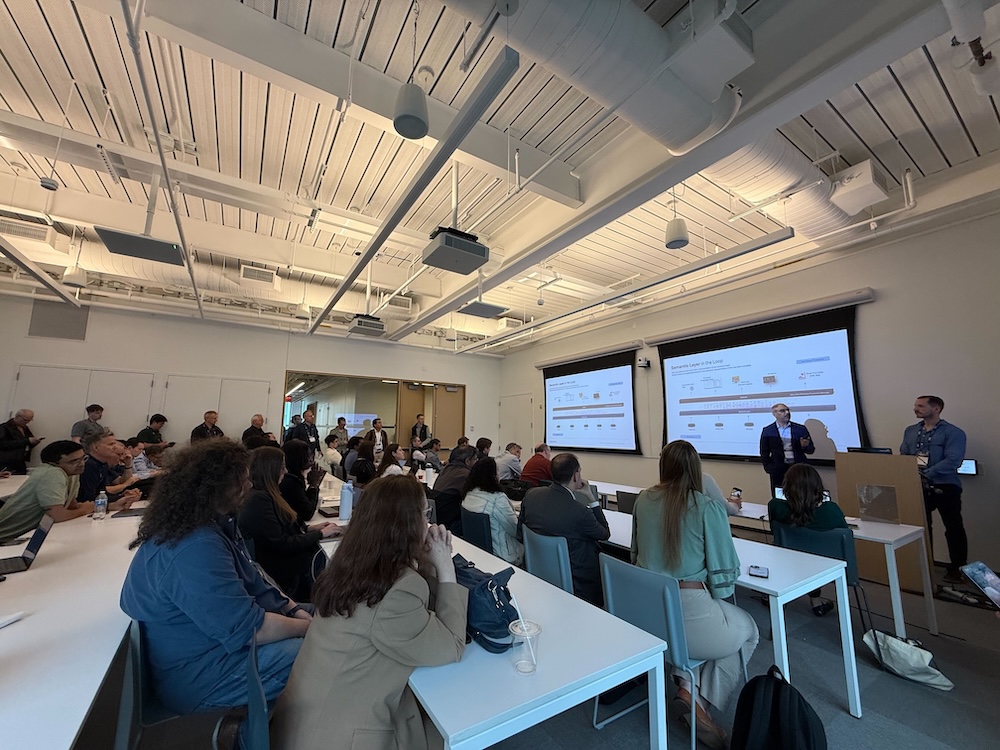
We had the great opportunity to present at the Knowledge Graph Conference 2026, for another year in a row. In this article, we recap our featured session titled "From Raw Data to Governed Insights," where experts from Morgan Stanley and metaphacts (Digital Science) detailed a cutting-edge approach to enterprise data management. Keep reading for key takeaways!
metaphacts and SAP HANA® Cloud

This article, republished from the SAP community blog, announces a new strategic partnership with SAP HANA®, enabling SAP HANA Cloud Knowledge Graph Engine integration on the metaphactory platform.
From data to decisions: How Enterprise AI, powered by Knowledge Graphs, is redefining business intelligence

Struggling to turn data lakes into actionable knowledge? Enterprise AI needs context. This article reveals how Knowledge Graphs and LLMs redefine business intelligence, safeguarding institutional wisdom and breaking data silos. Gain the competitive edge with truly data-driven decisions—keep reading!
Identifying causal relationships with knowledge graphs and large language models

In this article, we’ll discuss how LLMs and Symbolic AI drive precise, comprehensive and contextualized Causal Relationship Search and how it works in the Dimensions Knowledge Graph.
BIBFRAME dilemmas for libraries: Challenges and opportunities

In this article, Richard Wallis, a distinguished Linked Data and Semantic Web expert and thought leader, shares insights from the recent BIBFRAME Workshop in Europe where he presented a novel knowledge graph-powered solution created for a major national library. He also explores the common challenges that libraries currently face and the opportunities that technologies like linked data and knowledge graphs can offer for managing and connecting massive data volumes, as well as improving the experience for library users.
Revolutionizing HR Recruiting with Knowledge Graphs and LLMs: Introducing Zenia Graph's HR Recruiting Accelerator

Traditional HR recruiting often feels like searching for a needle in a haystack. Companies are inundated with resumes, and candidates are overwhelmed by the sheer number of job listings. Time-consuming manual processes, coupled with the challenge of finding the perfect candidate-job match, hinder efficiency and lead to suboptimal hiring decisions and missed opportunities. To revolutionize this critical function, Zenia Graph co-founders, Aurelije Zovko and Nina Zovko introduce their HR Recruiting Accelerator, a cutting-edge solution powered by the synergy of knowledge graphs and large language models.
Breathing new life into old drugs: The promise of drug repositioning

In the ever-evolving world of pharmaceuticals, an intriguing strategy has gained traction: drug repositioning. Also known as drug repurposing, reprofiling, redirecting, or switching— this approach involves finding new uses for existing medications. While it comes with its own set of challenges, drug repositioning offers several advantages, including a potential solution to the current slowdown in new drug discovery.
How to create a knowledge graph application with metaphactory and Amazon Neptune

This article is a follow-up in a series where we show how you can use metaphactory to build an end-user application using its dynamic model-driven components, driven by SPARQL queries. It originally appeared on the Amazon AWS blog and was republished and edited with permission from our partners at Amazon AWS.
How BKW Energie resolved smart meter choke points with a knowledge graph

This blog post is a recap of a presentation held at the 2023 Knowledge Graph Symposium about BKW Energie's smart meter operations, the data challenges they experienced and how knowledge graphs supported this complex use case.
Using knowledge graph-based LLM for relation & event detection

This post originally appeared on the Ontotext website and is republished and edited with the permission of our partners at Ontotext. In this blog post, we explore Ontotext’s latest knowledge graph-powered solution that works with LLMs to transform raw news content into actionable data for events impact assessment and risk and opportunity detection.
Introducing the Dimensions Knowledge Graph
In this blog post, we discuss the capabilities of the new Dimensions Knowledge Graph and how it helps organizations overcome persistent data challenges in the pharma space and power use cases across the entire pharma value chain. Keep reading!
We used a knowledge graph to enhance our CMS. Here’s how it went.
 In this blog post, we talk about how we created a knowledge graph-powered out-of-box metaphacts Resource Hub that integrates with our content management solution. We also discuss how you can achieve a similar integration with your CMS while reviewing the KompAKI knowledge hub, as another example.
Visualize and explore knowledge graphs quickly by connecting metaphactory to Amazon Neptune
 This post has also been published on the AWS Database blog.
In this post, we show you how to get started with knowledge graphs using the metaphactory platform backed by Amazon Neptune. Offered by AWS Partner Network (APN) Select Technology Partner metaphacts GmbH, metaphactory helps you build knowledge graphs and the smart applications that use them.
Fragmented knowledge in pharma: Bridging the divide between private and public data
This post has also been published on the Digital Science TL;DR website.
Despite the increasing availability of public data, why are so many pharma and life sciences organizations still grappling with a persistent knowledge divide? This discrepancy was a focal point at the recent BioTechX conference in October, Europe's largest biotechnology congress that brings together researchers and leaders in pharma, academia and business. In this post, we explore the need to connect data from different sources and all internal corporate data through one, integrated semantic data layer.
Introducing: Next-generation Semantic Search

When it comes to leveraging your enterprise data, having a wealth of quality data is only half the battle. The other half is having the right tools and technology to help you extract valuable insights from it and uncover new opportunities. That’s why we were eager to introduce metaphactory's Next-Generation Semantic Search (Next-gen Search), as part of the metaphactory 5.0 release.
The future of libraries and linked data: How the National Library Board of Singapore modernized its data management

In this blog post, we'll discuss the powerful knowledge graph-based solution that transformed NLB's library and resource management, and how you, too, can leverage these tools to support your organization's data-driven use case!
GraphDB & metaphactory Part II: An RDF Database and A Knowledge Graph Platform in Action

In our previous post, we covered the basics of how the Ontotext and metaphacts joint solution based on GraphDB and metaphactory helps customers accelerate their knowledge graph journey and generate value from it in a matter of days.
This post looks at a specific clinical trial scoping example, powered by a knowledge graph that we have built for the EU funded project FROCKG, where both Ontotext and metaphacts are partners. It demonstrates how GraphDB and metaphactory work together and how you can employ the platform's intuitive and out-of-the-box search, visualization and authoring components to empower end users to consume data from your knowledge graph.
You can also listen to our on-demand webinar on the same topic or check out our use case brief.
An Interconnected System for Reference Data

Publishing FAIR data in the humanities sector
Reference data is a crucial element of data curation in the cultural heritage and humanities sector. Using reference data brings multiple benefits, such as consistent cataloguing, easier lookup and interaction with the data, or compatibility with other data collections that use the same reference data. Overall, the use of reference data can support the publication of FAIR data - data that is findable, accessible, interoperable and reusable.
In museum collection management, for example, various thesauri can be used as reference data to ensure the accurate and consistent cataloguing of items in a controlled manner and according to specific terminologies. Thesauri exist for various areas of expertise. One example is the Getty Art and Architecture Thesaurus® (AAT) which describes the different types of items of art, architecture and material culture, such as "cathedral" as a type of religious building. Authority data has also been published to support the unique identification of specific entities such as persons, organizations, or places, for example, "Cologne cathedral" as a specific instance of the type "cathedral". Such authority data sources include The Integrated Authority File (GND) or the Union List of Artist Names® Online (ULAN) and are specifically important for disambiguating over entities with the same name, e.g., Boston, the town in the UK, and Boston, the city in the USA.
Digital humanities projects often combine several research directions and use materials that cover multiple disciplinary areas. This makes the implementation of reference data difficult, as several reference data sources need to be used to cover all aspects and facets of a project. Moreover, technical access to reference data is inconsistent, with systems using different interfaces and APIs, which makes integration challenging.
Investigative knowledge graph exploration & targeted problem solving with metaphactory’s pathfinding interface
Finding paths in a graph is a well defined space in mathematics and computer science. The Seven Bridges of Königsberg problem from 1736 - which asked to devise a roundtrip through the city of Königsberg in Prussia while crossing each bridge in the city only once - is one of the most famous real world problems and resulted in the foundations of today's graph theory.
While the term pathfinding might often be associated with finding the shortest path (for example, in a geographical context or in computer networks), the seven bridges problem is a good example showing that the shortest path is not necessarily the optimal or desired path for a given problem or information need.
GraphDB & metaphactory Part I: Generating Value from Your Knowledge Graph in Days
Large enterprises have identified knowledge graphs as a solid foundation for making data FAIR and unlocking the value of their data assets. Data fabrics built on FAIR data drive digital transformation initiatives that put companies ahead of the competition.
But while the benefits of knowledge graphs have become clear, the road to their implementation has often been long and complex, and success has relied on the involvement of seasoned knowledge graph experts.
This blog post goes through the basics of the joint solution delivered by Ontotext and metaphacts to speed up this journey.